If you own property in Downtown Fort Worth, mixed-use may be one of the most compelling ways to think about long-term value. This submarket is no longer supported by office demand alone, and that matters when you are evaluating a repositioning, acquisition, or lease-up strategy. With workers, residents, hotel guests, and major public investments all shaping activity downtown, you need a clear view of what supports mixed-use performance and what can complicate it. Let’s dive in.
Why downtown still supports mixed-use
Downtown Fort Worth continues to offer a broader demand base than many owners assume. According to Downtown Fort Worth Inc.’s office summary, downtown had 11.3 million square feet of office space in 2025, an 11.8% vacancy rate, and 50,000 square feet of positive absorption. The same report estimates 52,800 workers, 1,414 private-sector employers, and nearly $4 billion in annual payroll.
That office base is only part of the story. Downtown Fort Worth’s residential summary reports about 11,300 residents, 7,079 multifamily units, 1,592 units in the pipeline, and a 14% multifamily vacancy rate at the end of 2025. It also shows hotel inventory reaching 3,999 rooms with 69% occupancy in the fourth quarter of 2025.
For owners, that mix matters because it points to more than one source of demand. Rather than relying on a single office-heavy audience, mixed-use assets can potentially serve weekday workers, nearby residents, and visitors attending conventions, events, dining, or entertainment downtown.
Foot traffic trends reinforce that case. Downtown Fort Worth Inc. reported that walking traffic was up roughly 25% since 2022, helped by office returns and convention, hotel, and restaurant activity. That does not guarantee success for every property, but it does suggest a stronger operating environment for well-positioned ground-floor uses.
Plan 2033 supports a mixed-use future
The city’s long-range direction also matters when you are underwriting a hold or redevelopment strategy. Plan 2033 describes downtown as an active mixed-use district serving offices, hotels, restaurants, live theater, higher education, retail, residents, and recreation seekers. Its core goals include livable neighborhoods, a diversified economy, distinctive places, and seamless connections.
For owners, that framework is useful because it signals policy support for a balanced downtown environment. If you are evaluating capital improvements or a longer repositioning timeline, it helps to know the broader vision is not centered on a single property type.
Start with zoning and design review
Before you focus on rents, tenant mix, or finish levels, verify what the parcel can actually support. In the downtown core, the central business (H) district is the main zoning tool. The ordinance states that the H district is intended for more intense commercial use with less restrictive height and area standards, and within the district there is no front yard or rear yard requirement, no height restriction, and no off-street parking requirement.
That flexibility can be attractive, but it is not the whole approval picture. Downtown also has an Urban Design District overlay, and a Certificate of Appropriateness is required before a building permit for new structures and many exterior changes. That can include expansions, surface parking lots, signs, awnings, sidewalk work, and lighting fixtures.
This is one of the most important issues for owners to understand early. A project may appear straightforward on paper, but exterior modifications and frontage improvements can trigger a design-review process that affects timing, scope, and cost.
The city also identifies four downtown character zones within the overlay: Downtown Core, Greenway Neighborhood, Rock Island/Samuels Avenue Neighborhood, and Industrial Gateway. Those distinctions can shape how a project is reviewed and how a building fits its immediate context.
Nearby parcels may fall under different rules
Not every opportunity near downtown sits inside the CBD zoning framework. For parcels just outside the core, form-based districts such as MU-2 may be more relevant. The city says MU-2 is intended for higher-density housing among commercial, institutional, and selected light-industrial uses, with an emphasis on compact, walkable, revenue-positive development.
The city also describes Near Southside as a mixed-use development zone that encourages pedestrian-oriented urban development, while Panther Island is presented as a mixed-use, primarily residential neighborhood opportunity near the downtown core. If your property sits on the edge of downtown, zoning assumptions can change quickly from one block to the next.
How to underwrite street-level retail
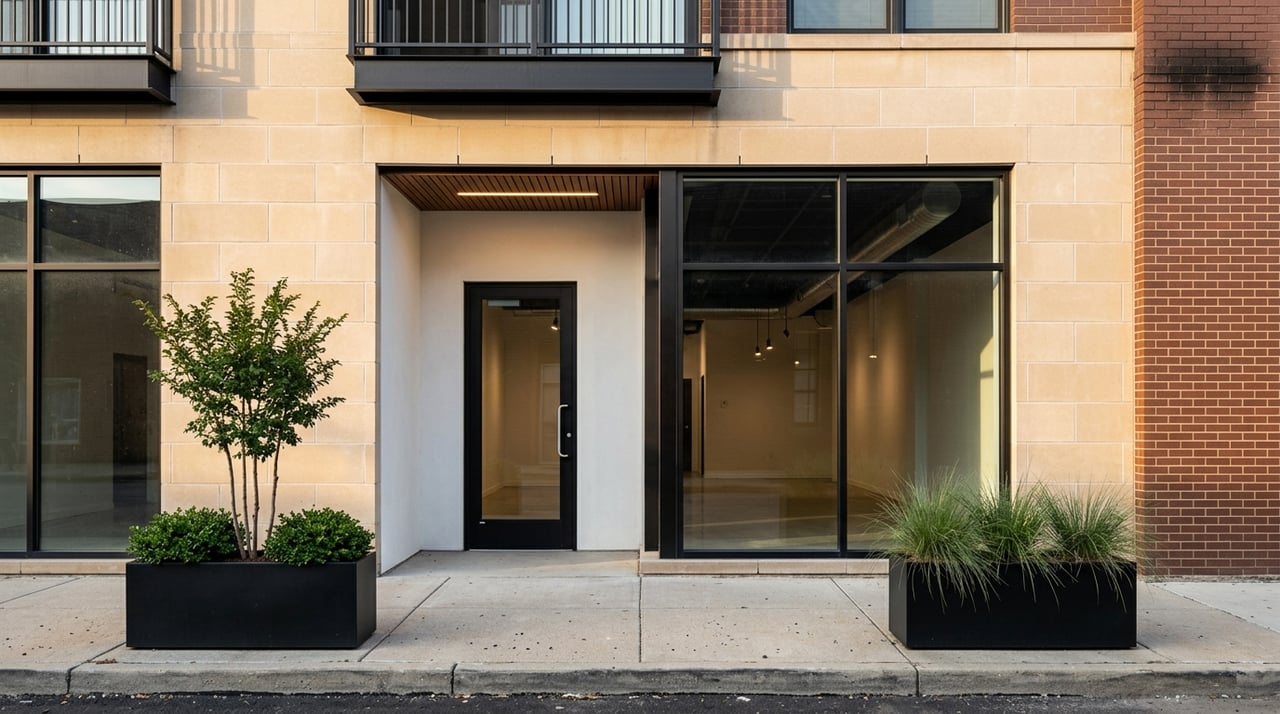
For most mixed-use owners, the core question is simple: can this location convert downtown activity into steady rent? The strongest retail strategy usually comes from matching the property to several daily demand pools rather than just one. In Downtown Fort Worth, that often means considering how a space serves office users during the week, residents nearby, and evening or weekend visitors.
The available market data supports that approach. With a large worker base, growing residential presence, active hospitality inventory, and convention-related traffic, owners may want to prioritize concepts that perform across breakfast, lunch, after-work, and event-driven periods rather than relying on a single daypart.
Public support systems also matter to the underwriting. Downtown’s TIF program is designed to attract office, retail, and residential development while improving transit, tourism, and convention business. Downtown Fort Worth Inc. also administers functions tied to the public improvement district, which supports maintenance, landscaping, safety, transportation planning, marketing, and ambassador services.
Model parking as a real cost
One common mistake in downtown underwriting is treating parking as a secondary issue because the zoning may not require it. Even where off-street parking is not required in the H district, your tenants and customers still react to access, convenience, and price.
The city’s downtown parking information shows that rates vary by location. Examples include the City Hall lot at $2 per hour with an $8 daily maximum, the Houston and Commerce Street garage ranging from $3 to $24 daily depending on duration, and monthly parking at $150 for non-reserved spaces and $400 for reserved spaces.
That means parking economics should be modeled separately in your pro forma. For some users, nearby public parking may be sufficient. For others, the lack of convenient access can affect achievable rent, lease-up pace, or the type of tenant you should target.
Public projects can change the value equation
Several public projects are worth watching because they can improve the long-term case for downtown mixed-use ownership. The city’s Main Street Downtown Intersections project is adding pedestrian-safety signals, ADA ramps, new traffic signals, and related improvements. For owners, better walkability and safer intersections can strengthen the street-level retail environment over time.
The Fort Worth Convention Center expansion is another major catalyst. Phase 2 is estimated at $606 million and is targeted for completion in 2030, while Downtown Fort Worth Inc. notes the project is expected to create demand for more hotels and support restaurant and retail sales. Its hospitality reporting also notes that Phase 1 created three new developable city blocks.
Higher education is also entering the picture. Texas A&M Fort Worth says its campus is opening in Fall 2026 and is intended to serve as the academic anchor for an innovation district in North Texas. The downtown TIF annual report notes that construction of the campus should have enormous long-term impact on the CBD.
Owners with a longer hold horizon should pay attention to these catalysts because they can influence future tenant demand, pedestrian patterns, and redevelopment interest.
Incentives may be worth reviewing
If your project qualifies, incentives should be part of the conversation early rather than late. The city’s economic development incentive guidance states that tax abatements and Chapter 380 grants may be available based on value added, and abatements may apply to property located in a tax increment reinvestment zone.
The same guidance notes that if the property is leased, professional legal guidance is advisable because only certain elements of leased property may be eligible. For owners, the practical takeaway is to review incentive potential before finalizing the business plan, especially if the project includes substantial exterior, accessibility, or tenant-improvement costs.
Build the right advisory team
Downtown mixed-use deals usually perform best when owners treat them as team sports. On the public side, key contacts may include city zoning staff, the Downtown Design Review Board process, Downtown Fort Worth Inc., and the city’s Economic Development team. Downtown Fort Worth Inc. describes itself as a liaison, ombudsman, and information source for property owners, residents, business owners, lenders, community organizations, and policymakers.
On the private side, owners often benefit from working with land-use counsel, an architect familiar with downtown review, a leasing broker who understands street-level retail, a lender comfortable with mixed-use deals, and a contractor or property manager who can estimate improvement and operating costs accurately.
This is where a boutique, senior-level advisory approach can make a difference. Downtown deals often involve moving parts across zoning, design review, tenant strategy, and timing, so coordinated guidance matters.
A practical due diligence sequence
If you are evaluating a downtown mixed-use purchase or repositioning, a simple sequence can help keep the process disciplined.
- Verify the base zoning district and any overlay requirements.
- Confirm allowable uses for the specific parcel.
- Review parking access and nearby pedestrian generators.
- Model capital needs for frontage, signage, lighting, and accessibility.
- Align lease-up strategy with the block’s daypart traffic.
- Review whether incentives may apply before final underwriting.
That kind of process helps you avoid a common problem: underwriting the vision before confirming the rules and the real cost to execute it.
What mixed-use owners should take away
Downtown Fort Worth remains a credible mixed-use ownership story because demand comes from multiple directions, not just one. Workers, residents, hotel guests, and major public investments all contribute to a more layered downtown environment. At the same time, zoning details, design review, parking realities, and block-by-block context still matter enough to make early diligence essential.
If you are considering a downtown acquisition, repositioning, or tenant strategy, the goal is not just to find a property that looks promising. It is to understand how that asset fits the regulatory framework, the public investment pipeline, and the daily demand patterns that can support long-term performance.
If you want a strategic, locally grounded perspective on Downtown Fort Worth ownership opportunities, Willoughby Agency offers senior-level advisory across commercial representation, landlord and tenant guidance, development strategy, and complex real estate transactions.
FAQs
What makes Downtown Fort Worth viable for mixed-use owners?
- Downtown Fort Worth has multiple demand drivers, including 52,800 workers, about 11,300 residents, 3,999 hotel rooms, and rising foot traffic, which can support a broader mix of uses.
What zoning should Downtown Fort Worth owners check first?
- Owners should first verify whether the property is in the central business (H) district and whether the Downtown Urban Design District overlay also applies.
What is a Certificate of Appropriateness in Downtown Fort Worth?
- It is a city approval required before a building permit for new structures and many exterior changes in the downtown urban design area, including some signage, lighting, awnings, and expansion work.
How should Downtown Fort Worth owners think about parking?
- Even if zoning does not require off-street parking, owners should still model parking cost and access carefully because tenant demand and customer convenience can affect rents and lease-up.
Are there incentives for Downtown Fort Worth mixed-use projects?
- Depending on the project and location, tax abatements and Chapter 380 grants may be available, so it is worth reviewing eligibility early in the planning process.
Which public projects could affect Downtown Fort Worth property values?
- The convention center expansion, Main Street intersection upgrades, and the Texas A&M Fort Worth campus are all notable catalysts that could influence future downtown activity and demand.